
RollConverter: the quality and production cockpit for web converting
Your inspection system already sees every defect on the web. RollConverter turns that seeing into decisions — where to slit, what to reject, what to ship, and what the operator downstream needs to know.
The layer between the camera and the cut
An inspection system produces an enormous, faithful record of a jumbo roll: tens of thousands of events, each with a position, a class and an image. What it does not do is tell you what to do with the roll.
So the knowledge lives in people. The quality lead knows which flagged events are real and which are the camera's habitual false positives. The planner knows the customer specification and works out by eye which slit plan puts the bad metres into scrap instead of into the premium order. The rewinder operator has a printed map, or nothing at all, and finds the defect by slowing down and looking.
Every handoff between those people loses information. RollConverter closes the loop: one place where inspection data is curated, converted into a slit plan, graded against the customer's standard, and pushed to the machine that needs it — with the source data never touched.
What RollConverter is
A browser-based application that sits alongside your inspection systems, reads from them, and never writes back to them. It:
reads roll inspection data from one or more inspection installations,
optimises slitting from the known quality of the incoming roll,
lets a reviewer curate the defect record before it goes anywhere,
grades rolls and daughter rolls against real customer specifications,
serves the result to RollTagger devices on the shop floor — and to AI agents.
It is deliberately not a controller and not a replacement inspection system. It is the layer between the camera and the cut.
Interactive maps and true defect metrology
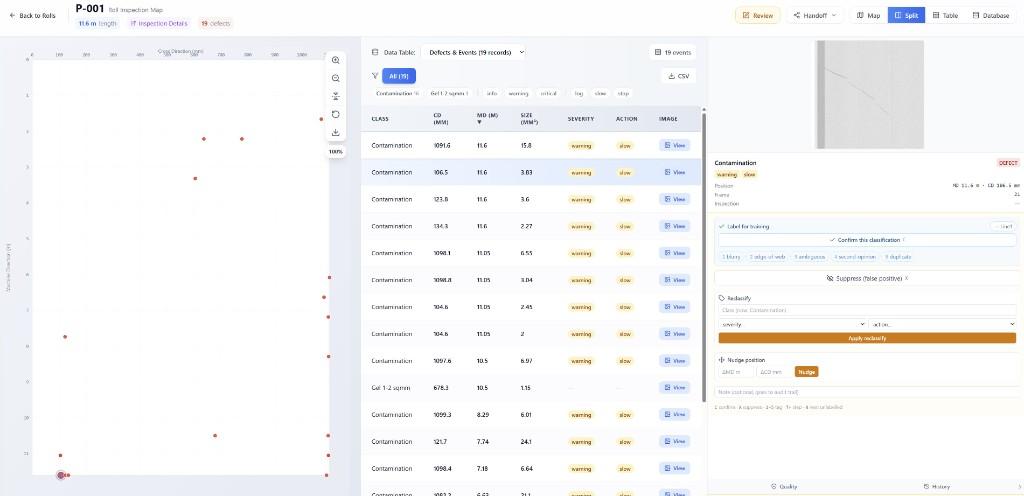
Every roll opens as an interactive map — machine direction in metres, cross direction in millimetres — with zoom, pan, filtering by class, severity and action, sortable event tables, a docked image preview, and arrow-key stepping through events. Defect images are proxied straight from the inspection system's own image store.
Working from the measured blob also sharpens positions: machine-direction resolution goes from frame-level to per-defect, and cross-direction positions are referenced to the actual web edge — which decides which daughter roll a defect is assigned to.
Slitting, review, and an audit trail that sticks
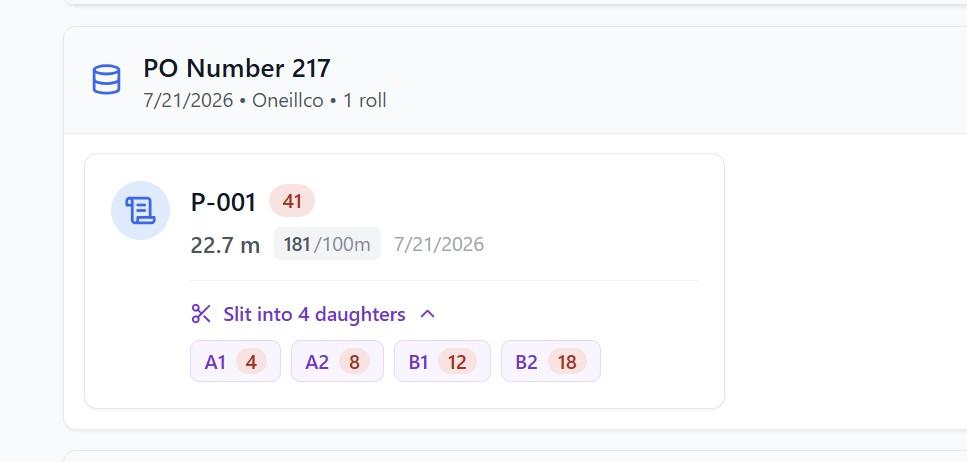
Partition a roll into daughter rolls — cross-direction ribbons × machine-direction segments — and browse every daughter as a first-class roll with its own map, its own defect list and its own grade. Slit profiles turn a recipe ("3 across, 1000 m segments, 40 mm trims") into a one-click parametric product spec applied to any roll, with a dry-run preview before committing.
The camera is not always right. A reviewer can suppress false positives, reclassify events, nudge positions, confirm a label as correct, or add events the camera missed — each action recorded append-only, attributed, and time-stamped. Every edit composes automatically into daughter rolls, merges, exports, reports and handoffs. The source inspection data is never modified.
Merges combine rolls into composite views — top and bottom surface inspections of the same web, for instance — including across different inspection sources.
Grade against the customer's actual specification
Build the customer's standard into the system and let it judge:
Applications are product families (blown film, nylon film, printed laminate), each owning its own operator-editable defect-type list.
Aliases map what the camera actually emits ("Defect 1", "Large Defect") onto the operator's vocabulary. On production data, ten aliases lifted coverage from 36.8% to 97.95% of events.
Policies attach rules to those types — none allowed, max count per unit area by size band, max single size, max cumulative area, max dimension — with a per-unit-area basis, exactly as real specifications state them ("per 3 square feet").
Revisions are immutable. Customers cite "Rev 14", so a verdict recorded last month still names the standard it was graded against.
Verdicts are per roll and per daughter, because the daughter is what ships. Failing windows are shaded on the map, failing rules select their contributing events, and the verdict recomputes live as the reviewer suppresses false positives. Enforcement is graded — advisory, warn, or block — and handoff is gated accordingly.
Handoff to RollTagger, reports, and AI
Offer any roll or daughter for paired RollTagger devices to pull as a signed .rtag package — events, measurements, slit plan, quality verdict and full audit trail included, integrity-hashed on the way out. Machine-direction orientation is handled explicitly: rolls are presented rewound (the way they are inspected and graded) and exported as-wound (the way RollTagger unwinds them), so a defect reported at 12 m from the head is genuinely 12 m from the head.
Excel workbooks with the quality verdict, CSV event exports, image bundles, and frozen training datasets in COCO, YOLO, CSV-manifest or folders-by-class form are available — split by roll, not by event, because crops from one roll are near-duplicates and event-level splitting leaks between train and test.
A built-in MCP server exposes sources, rolls, defect maps, slit recipes, edits and handoff history as read-only tools. Point an AI assistant at it and ask "which slit plan on this roll maximises grade-A metres?" in plain language.
Who it is for
Quality managers — curate the defect record before it becomes a decision, hold every customer specification as an enforceable policy, and produce a defensible, audit-trailed grade for each shipped roll.
Production planners and slitter operators — see the defect landscape before cutting, apply a saved product recipe in one click, and compare the yield of alternative plans while the roll is still whole.
Rewinder and inspection-table operators — receive the roll on a RollTagger device with defects already positioned, classified, prioritised and stripped of false positives, and stop only where stopping is worth it.
Plant and operations managers — one cockpit across multiple inspection systems and production lines, with exportable reports and a machine-readable interface for analytics and AI.
Data and ML teams — a clean, labelled, image-backed defect corpus falling out of work the quality team was doing anyway.
What you gain
Yield you can point at. Slitting against the known defect map — with true millimetre geometry and per-daughter grading — puts bad metres where they cost least.
False positives stop propagating. Suppress an event once, and it is gone from every daughter, every export, every report and every device pull — without touching the inspection database.
Grading becomes reproducible. The same roll, the same policy revision, the same verdict — whoever is on shift.
Faster rewinding. Operators stop at real defects with real severities instead of slowing for everything the camera flagged.
Traceability by default. Every suppression, reclassification and handoff is attributed and time-stamped.
No risk to the inspection system. Read-only throughout. Nothing RollConverter does can corrupt or alter the system of record.
Your defect history becomes an asset. Inspection images are typically purged within weeks. RollConverter banks the pixels behind every label as it is made, so the corpus your future classifier needs accumulates from day one.
Need help with your machine vision project?
Consult with us free of charge to see if we can provide value to your project. We can help you define the scope and requirements.
Free consultationRelated articles
The key questions when specifying an inspection system for a roll to roll application
For effective defect detection, a web inspection system can be broken down into three key functional elements: the imaging system, the processing system, and the output system. Learn how to specify each correctly.
The digital twin approach to roll-to-roll waste tracking with vision systems
How digital roll mapping creates a virtual twin of your physical roll, enabling automated waste removal, yield optimization, and data-driven converting decisions across multiple process stages.