
The digital twin approach to roll-to-roll waste tracking with vision systems
How digital roll mapping creates a virtual twin of your physical roll, enabling automated waste removal, yield optimization, and data-driven converting decisions across multiple process stages.
Introduction: from inspection to intelligence
Traditional web inspection systems serve a single purpose — detect defects and alert the operator. The defect data lives and dies on that production line. Once the roll is slit, rewound, or shipped, the inspection data is archived (if at all) and rarely referenced again.
This represents an enormous missed opportunity. Every defect detected by your vision system carries spatial information — where on the web, how far from the edge, at what distance along the roll. When this data is captured, structured, and mapped to the physical roll, it creates something powerful: a digital twin of the roll itself.
What is a digital roll twin?
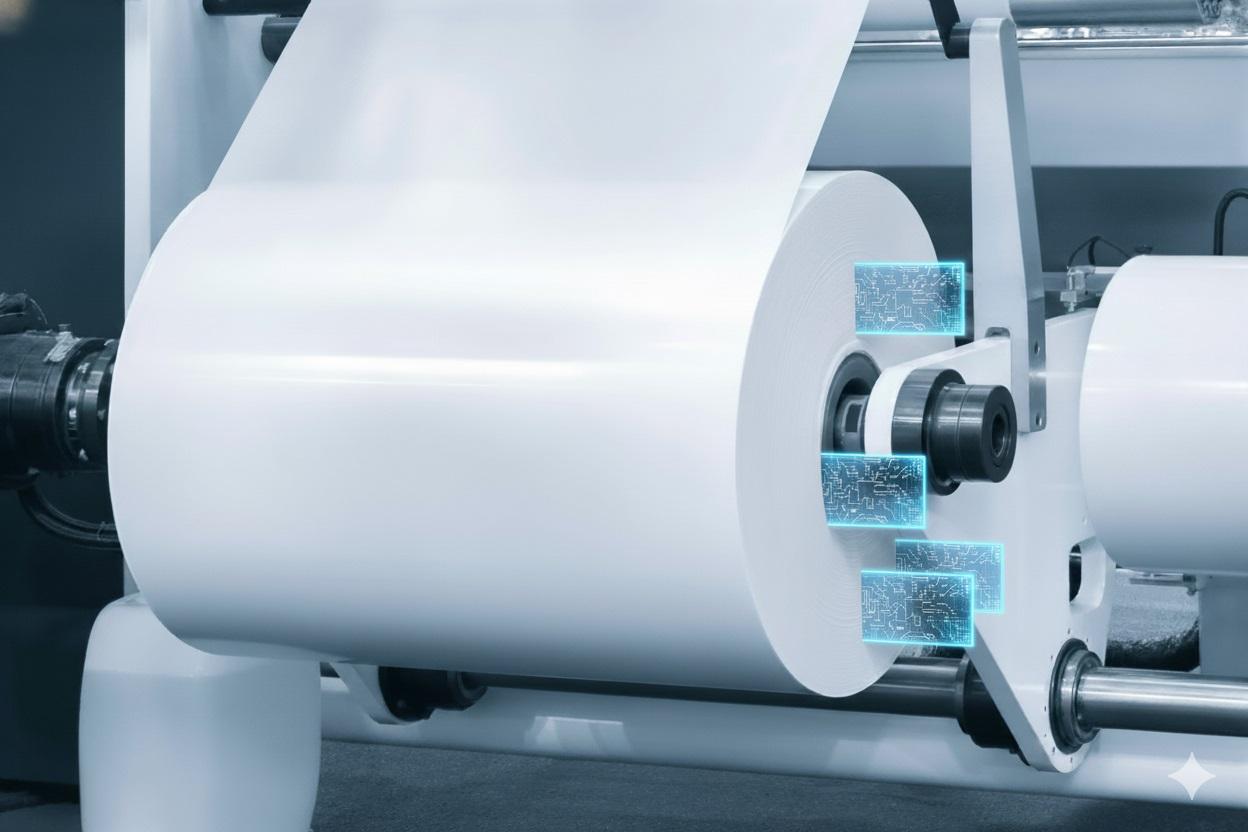
A digital roll twin is a virtual representation of a physical roll of material that contains a complete spatial map of every defect, measurement anomaly, and quality event detected during production. It mirrors the physical roll metre by metre, recording:
Defect positions — the exact X (cross-web) and Y (machine direction) coordinates of every detected defect, classified by type, size, and severity.
Process metadata — line speed, tension readings, temperature, and any other process variables captured at the time of detection.
Quality zones — areas of the roll graded by quality level based on defect density, enabling downstream decisions about how to use each section.
Edge and width profiles — continuous measurement data showing web width, edge position, and lane registration across the entire roll length.
This digital twin is created in real time as the roll is produced, and it travels with the roll through every subsequent process — slitting, converting, laminating, printing, or shipping.
How vision systems create the digital twin
The foundation of a digital roll twin is a high-resolution inspection system operating at full production speed. Line scan cameras — typically running at 100% web coverage — capture every square millimetre of the material surface. Advanced defect classification algorithms categorize each anomaly by type (gel, contaminant, hole, scratch, coating void, etc.) and record its precise position.
Encoder integration is critical. A rotary encoder coupled to the web or roller provides accurate machine-direction distance measurement, ensuring defect positions are mapped to real physical locations on the roll — not approximations based on line speed. Without reliable encoder data, the digital twin drifts out of synchronisation with the physical roll, making downstream waste removal inaccurate.
The inspection system writes defect data to a structured roll map in real time. This roll map is the digital twin — a complete quality record of the roll from the first metre to the last.
Tracking defects across multiple processes
Most roll-to-roll materials pass through multiple process stages: extrusion, coating, printing, lamination, slitting, and converting. Defects can be introduced at any stage, and a defect that is acceptable after extrusion may become critical after printing.
The digital twin approach solves this by accumulating defect data across processes. When a roll that was inspected during extrusion arrives at the coating line, its existing digital twin is loaded. New inspection data from the coating process is merged with the original map, building a progressively richer picture of the roll's quality.
This multi-stage accumulation means that by the time a roll reaches final converting, the digital twin contains a complete defect history — not just what happened on the last process, but everything that happened to that roll throughout its entire production lifecycle.
Automated waste removal on the unwind
The most immediate ROI from a digital roll twin comes from automated waste removal. In traditional operations, when defects are found during rewinding or converting, the operator must stop the machine, manually locate the defect, cut it out, splice, and restart. This is slow, error-prone, and wastes material around the defect because operators add generous safety margins.
With a digital twin, the approach is fundamentally different. The defect map created during the rewind (or any upstream process) is loaded when the roll is mounted on the unwind. The system knows exactly where every defect is before the roll starts moving. As the web unwinds, the system tracks position via encoder and automatically flags or removes defective sections with surgical precision — minimum waste, no manual searching.
This approach can reduce waste removal time by up to 80% and cut material waste by 30-50% compared to manual methods, because the system removes only what needs to be removed rather than applying conservative safety margins.
Yield optimisation through quality zoning
Not all defects are equal, and not all customers have the same quality requirements. A digital roll twin enables intelligent yield optimisation by grading different sections of the roll against specific quality criteria.
Consider a roll of printed flexible packaging material. A section with minor surface blemishes might be rejected for a premium cosmetic product but perfectly acceptable for an industrial application. By analysing the digital twin against multiple quality profiles, converters can allocate material to the most appropriate end use rather than rejecting entire rolls based on worst-case defects.
This quality zoning capability can recover 10-20% of material that would otherwise be scrapped, turning the inspection system from a cost centre into a yield optimisation tool.
Integration with MES and ERP systems
A digital roll twin becomes most powerful when integrated with manufacturing execution systems (MES) and enterprise resource planning (ERP). The quality data contained in the twin can drive automated decisions across the operation:
Production scheduling — Automatically route rolls to the most appropriate downstream process based on their quality profile.
Customer allocation — Match roll quality to customer specifications, ensuring that premium material goes to demanding customers and acceptable material is allocated rather than scrapped.
Supplier feedback — When raw material defects are tracked from incoming rolls through to final product, the data provides objective evidence for supplier quality discussions.
Compliance and traceability — In regulated industries like pharmaceutical packaging and food contact materials, the digital twin provides a complete, auditable quality record for every roll produced.
The technology stack
Implementing a digital twin for roll-to-roll waste tracking requires several interconnected technology components:
High-resolution line scan inspection — Full-width coverage at production speed with automated defect classification. Resolution must be appropriate for the smallest defect of interest (typically 50-250 μm for film and packaging applications).
Precision encoder integration — Rotary encoders providing accurate machine-direction position data, typically with resolution better than 1mm. Encoder mounting and coupling must be robust to avoid slippage.
Roll identification — Barcode, QR code, or RFID systems to uniquely identify each roll and link it to its digital twin. This is essential for multi-stage tracking.
Centralised data management — A database or server infrastructure that stores roll maps and makes them accessible at any process stage. Cloud-based or on-premise, depending on factory network architecture.
Unwind tracking software — Software that loads the digital twin at the unwind, synchronises with the encoder, and provides real-time defect position information to the operator or automation system.
Real-world impact: case example
A flexible packaging converter running multiple flexographic presses and laminating lines implemented digital roll twin tracking across their operation. Before implementation, defect-related waste was approximately 4.5% of total material throughput, and operators spent significant time manually searching for and removing defects during converting.
After implementing digital twin tracking with automated waste removal:
- Defect-related waste dropped to 1.8% — a 60% reduction - Converting line efficiency increased by 12% due to reduced stops for manual defect removal - Customer complaints related to defects decreased by 75% - The system paid for itself within 8 months through material savings alone
Critically, the data accumulated in the digital twins also revealed upstream process issues that had previously gone undetected, enabling proactive maintenance and process improvements that further reduced defect rates over time.
Getting started
Implementing a digital twin approach does not require replacing existing inspection systems overnight. A practical path forward is:
Stage 1: Audit your current inspection data. Understand what defect data you currently capture and how it is stored. Many existing inspection systems already generate defect maps — the data may simply not be used.
Stage 2: Implement roll identification. Ensure every roll can be uniquely identified and tracked through your process. This is the foundation for linking digital twins to physical rolls.
Stage 3: Start with one process pair. Choose one upstream inspection point and one downstream converting operation. Implement digital twin tracking between these two points and measure the waste reduction.
Stage 4: Expand across the operation. Once the value is proven on one process pair, extend the digital twin tracking to additional process stages, building a complete quality history for every roll.
The key is to start with a clear, measurable objective — typically waste reduction on a specific converting line — and build from there.
Conclusion
The digital twin approach transforms web inspection from a reactive quality gate into a strategic manufacturing asset. By creating a virtual representation of every roll that accumulates quality data across multiple process stages, manufacturers gain the ability to make intelligent, data-driven decisions about waste removal, material allocation, and process improvement.
The technology to implement this approach exists today — high-speed line scan cameras, precision encoders, structured data management, and intelligent converting software. The barrier is not technology but mindset: moving from "inspect and alert" to "inspect, map, track, and optimise."
For roll-to-roll manufacturers operating in competitive markets with tight margins, the digital twin approach offers a proven path to significant waste reduction, improved yield, and better customer quality — turning inspection data into a genuine competitive advantage.
Need help with your machine vision project?
Consult with us free of charge to see if we can provide value to your project. We can help you define the scope and requirements.
Free consultationRelated articles
RollConverter: the quality and production cockpit for web converting
Your inspection system already sees every defect on the web. RollConverter turns that seeing into decisions — where to slit, what to reject, what to ship, and what the operator downstream needs to know.
Optimizing your chances of success using deep learning in machine vision
Deep learning in machine vision depends heavily on how data is managed, not just the choice of model. Learn the data-centric approach to maximizing success.
The key questions when specifying an inspection system for a roll to roll application
For effective defect detection, a web inspection system can be broken down into three key functional elements: the imaging system, the processing system, and the output system. Learn how to specify each correctly.