
Technology — Lighting Solutions
Lighting makes or breaks the image
No amount of software can recover information that was never captured. We design and configure LED illumination systems — from ring lights to structured laser projection — that deliver the contrast, uniformity, and spectral properties your application demands.
8
Lighting techniques
UV–IR
Wavelength range
10×
Strobe overdrive
> 95%
Backlight uniformity
Ring Lights
Uniform, shadow-free direct illumination
Ring lights mount directly around the camera lens, projecting light along the optical axis. This geometry delivers uniform, shadow-free illumination on flat and low-profile surfaces — the most common starting point for machine vision lighting.
How it works
An annular array of LEDs surrounds the lens aperture, directing light straight down onto the object from all radial directions simultaneously. Because the light source encircles the lens, shadows cast by surface features are filled from every angle, producing extremely even illumination with minimal shadowing on flat targets.
Think of it this way: Picture a ring of stadium floodlights arranged in a circle directly above a football pitch. Every point on the field is lit from all sides equally, eliminating the long shadows you would get from a single spotlight on one side.
Best for
- Flat surface inspection and scratch detection
- PCB and electronic component inspection
- Barcode and label reading at close range
- Color and print quality verification
- Low-angle variants for highlighting surface texture
Key specifications
- Inner diameters from 10 mm to 150 mm+
- High-angle (direct) and low-angle (dark field) variants
- White, red, blue, green, and IR wavelengths
- Continuous and strobe (overdrive) operation
- Diffuse and spot models available
Bar (Linear) Lights
High-intensity directional illumination
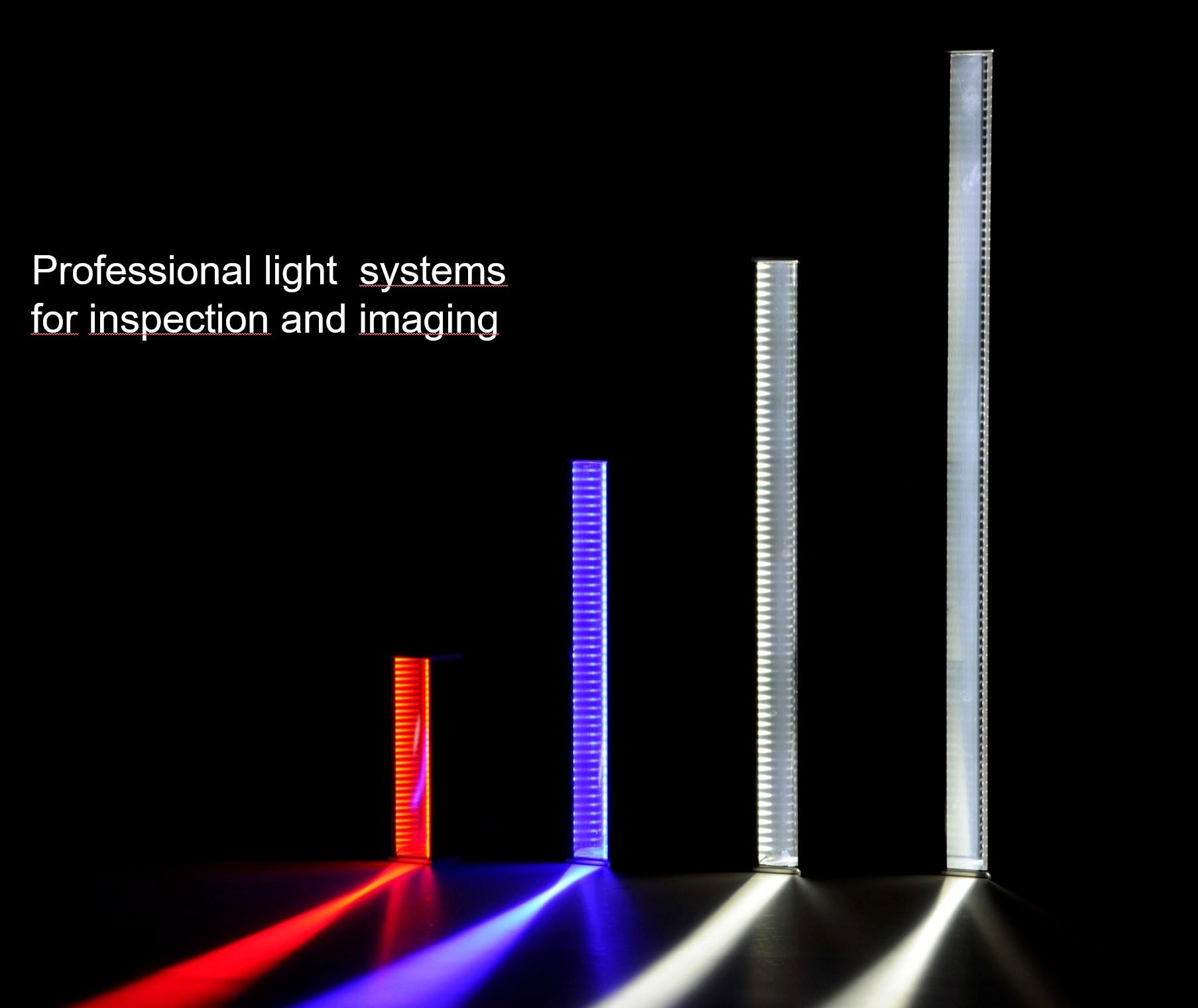
Bar lights are elongated, linear LED arrays that provide a concentrated curtain of light along a single axis. They are the standard illumination choice for line scan camera applications and any setup requiring directional, high-intensity lighting across a wide field.
How it works
A dense row of LEDs is arranged in a linear housing with integrated optics (lenses or reflectors) that collimate or focus the light into a narrow, high-intensity stripe. Multiple bars can be angled and positioned around the target to create bright field, dark field, or directional lighting geometries.
Think of it this way: Think of the fluorescent tube lights above a workbench — except engineered to concentrate all their output into a thin, precise curtain of light rather than flooding the entire room.
Best for
- Line scan camera illumination on web inspection systems
- Wide-field area scan applications
- Directional side-lighting for surface defect detection
- High-speed conveyor and sortation systems
- Multi-bar setups for complex lighting geometries
Key specifications
- Lengths from 50 mm to 2,000 mm+
- Spot and flood beam angle variants
- High-intensity strobe capable (up to 10× continuous brightness)
- White, red, blue, green, IR, and UV wavelengths
- IP65/67 washdown-rated housings available
Backlights
Silhouette imaging for edge and profile measurement
Backlights are uniform, flat-panel LED sources placed behind the object, directly opposite the camera. They turn the object into a high-contrast silhouette, making edges, holes, profiles, and dimensional features stand out with maximum sharpness.
How it works
A dense LED array behind a diffusion panel produces an extremely uniform, flat illumination surface. The object is placed between this light source and the camera, blocking the light and creating a crisp, high-contrast shadow. The camera sees only the object's outline against a bright, featureless background.
Think of it this way: The same principle as shadow puppets — you place an object between a bright wall and your eyes, and you see a perfectly sharp outline. The brighter and more uniform the wall, the sharper and more precise the silhouette.
Best for
- Dimensional gauging and profile measurement
- Edge detection with sub-pixel precision
- Hole, slot, and feature presence/absence checks
- Threaded fastener and pin inspection
- Telecentric lens pairings for precision metrology
Key specifications
- Sizes from 10 × 10 mm to 600 × 600 mm+
- Uniformity > 95% across the active area
- Telecentric backlight variants for parallel-ray illumination
- Collimated and diffuse models
- Red, white, blue, green, and IR wavelengths
Dome Lights
Diffuse, omnidirectional illumination
Dome lights create the most uniform, shadow-free illumination possible by bouncing LED light off the interior of a hemispherical dome. They completely surround the object in diffuse light from every angle, eliminating specular reflections and hot spots on shiny or curved surfaces.
How it works
LEDs mounted inside a hemispherical housing project light upward onto the dome's white interior surface, which acts as a diffuse reflector. The light bounces down onto the object from every conceivable angle simultaneously. A port at the top allows the camera to image through the dome. This geometry is sometimes called "cloudy day" illumination.
Think of it this way: Imagine placing an object under a perfectly overcast sky — light arrives equally from every direction with no direct sun, so there are no harsh shadows or glare spots. A dome light recreates this effect in a compact, controlled enclosure.
Best for
- Inspecting highly reflective surfaces (metals, foils, glass)
- Curved and irregularly shaped objects
- Label and print reading on glossy packaging
- Solder joint inspection on PCBs
- Any application where specular glare must be eliminated
Key specifications
- Dome diameters from 50 mm to 400 mm+
- Internal white diffuse coating for maximum uniformity
- Integrated camera port at the apex
- White, red, blue, green, and multi-color variants
- Flat dome and deep dome profiles for different working distances
Dark Field Illumination
Revealing surface defects through grazing angles
Dark field lighting projects light at extremely low angles — nearly parallel to the object surface. Only light scattered by surface irregularities (scratches, edges, particles, texture changes) reaches the camera, while smooth surfaces remain dark. Defects glow against a black background.
How it works
The light source is positioned at a very low angle relative to the surface plane (typically < 15°). On a smooth, flat surface, the light reflects away from the camera, leaving the image dark. But where there is a scratch, raised edge, contaminant, or surface texture change, the light is scattered upward toward the camera, making the defect appear bright against the dark background.
Think of it this way: The same effect as running a flashlight across a wooden table at a very low angle late at night. The surface looks dark and uniform, but every scratch, dust particle, and grain imperfection suddenly glows brightly because it scatters the grazing light toward your eyes.
Best for
- Scratch and micro-crack detection on polished surfaces
- Particle and contamination detection
- Surface texture and roughness analysis
- Wafer edge and flat-panel defect inspection
- Detecting raised or recessed features on flat parts
Key specifications
- Illumination angles typically 5° to 15° from the surface
- Implemented via low-angle ring lights, bar lights, or custom fixtures
- High-intensity strobe for fast-moving targets
- Works with both area scan and line scan systems
- Often combined with bright field in multi-angle setups
Coaxial (On-Axis) Lights
Specular reflection for mirror-like surfaces
Coaxial lights project illumination along the exact same axis as the camera lens using a beam splitter. This creates perfectly even lighting on flat, mirror-like surfaces — making surface defects, etchings, and markings on highly reflective materials visible where other lighting techniques fail.
How it works
An LED light source projects through a half-mirror (beam splitter) mounted at 45° between the lens and the object. The light travels straight down along the optical axis, reflects off the flat, specular surface directly back through the beam splitter into the camera. Any surface deviation — a scratch, etched mark, or height change — scatters light away from the axis and appears dark against the bright, uniform background.
Think of it this way: Like looking straight down at a calm lake — you see a perfect, bright reflection of the sky. But any ripple, oil slick, or floating debris disrupts the mirror surface and becomes immediately visible as a dark disturbance.
Best for
- Inspecting polished metal, glass, and wafer surfaces
- Reading laser-etched marks and engravings on shiny parts
- Detecting scratches and pitting on specular surfaces
- Flat surface uniformity verification
- BGA and flip-chip solder inspection
Key specifications
- Integrated beam splitter for true on-axis illumination
- Field sizes from 5 × 5 mm to 100 × 100 mm+
- High uniformity across the illuminated area
- White, red, blue, and IR wavelengths
- Compact housings designed to mount between lens and camera
Structured & Pattern Projection
Active illumination for 3D and special applications
Structured light projectors emit precisely defined patterns — laser lines, grids, dot arrays, or coded stripe sequences — onto the object surface. By analyzing how these patterns deform, the vision system extracts 3D shape, height, and surface topology information.
How it works
A laser or LED projector casts a known geometric pattern onto the target. An angled camera observes how the pattern deforms across the surface. Triangulation algorithms convert the measured distortion into a dense 3D point cloud or height map. For laser line profiling, a single line sweeps across the object as it moves, building a 3D profile scan line by line.
Think of it this way: Imagine projecting a perfectly straight grid of lines from an overhead projector onto a crumpled piece of paper. Where the paper rises or dips, the lines bend and distort. By measuring exactly how each line bends, you can reconstruct the 3D shape of the paper's surface.
Best for
- 3D surface profiling and height measurement
- Weld seam tracking for robotic welding
- Volume and fill-level inspection
- Robot guidance and bin picking
- Surface flatness and warp measurement
Key specifications
- Laser wavelengths: 405 nm, 450 nm, 520 nm, 660 nm, 830 nm
- Line, multi-line, dot matrix, and coded pattern options
- Fan angles from 5° to 120°
- Class 1, 2, or 3R laser safety ratings
- Integrated with 3D cameras or standalone projection units
Multi-Wavelength & UV Lighting
Spectral control for material-specific contrast
By choosing specific LED wavelengths — from deep UV through near-infrared — lighting can be tuned to maximize contrast on specific materials, reveal hidden features, or excite fluorescence. Multi-channel controllers allow switching wavelengths dynamically within a single inspection station.
How it works
Different materials absorb and reflect light differently at each wavelength. By selecting a wavelength that maximizes the contrast between the feature of interest and the background, defects or markings that are invisible under white light become clearly visible. UV lighting additionally excites fluorescent materials, making coatings, adhesives, and contaminants glow brightly.
Think of it this way: Like using a blacklight at a crime scene — substances invisible under normal room lighting suddenly fluoresce and glow vividly when exposed to ultraviolet light, revealing exactly where they are.
Best for
- Fluorescence inspection (adhesives, coatings, lubricants)
- Maximizing contrast on specific colored defects
- Pharmaceutical and food safety inspection
- Detecting invisible UV-cured coatings and markings
- Multi-spectral imaging with wavelength-switching controllers
Key specifications
- UV (365 nm, 395 nm), visible (red, green, blue, white), IR (850 nm, 940 nm)
- Multi-channel controllers for dynamic wavelength switching
- Strobe and continuous operation modes
- Available in ring, bar, backlight, and dome form factors
- High-intensity UV options with proper safety shielding
Choosing the right lighting
Lighting is the single most important factor in machine vision image quality. The wrong lighting cannot be corrected by software. Here are the factors we evaluate for every application.
Matte surfaces work well with direct lighting; shiny or reflective surfaces require dome, coaxial, or dark field techniques to control specular reflections.
Surface defects (scratches, particles) are best revealed by dark field. Profile and dimensional features need backlighting. Print and color require diffuse, even illumination.
Flat parts suit bar and ring lights. Curved or cylindrical surfaces need dome lights. Internal features may require coaxial or structured light.
High-speed lines benefit from strobe illumination, which can overdrive LEDs to 10× continuous brightness during short exposures — freezing motion without blur.
Choosing the right wavelength maximizes contrast. Red on green defects, blue for surface features, UV for fluorescence, IR for seeing through certain materials.
The distance between the light and the object, combined with the field of view, determines whether you need a compact ring light or a multi-meter bar light array.
Related technology
Great lighting needs the right camera and optics to match. Explore the rest of the imaging chain.
Ready to solve your vision challenge?
Tell us about your application. Our engineers will evaluate your requirements and recommend the right approach — no obligation.