
Technology — Optics & Lenses
The optics define the image
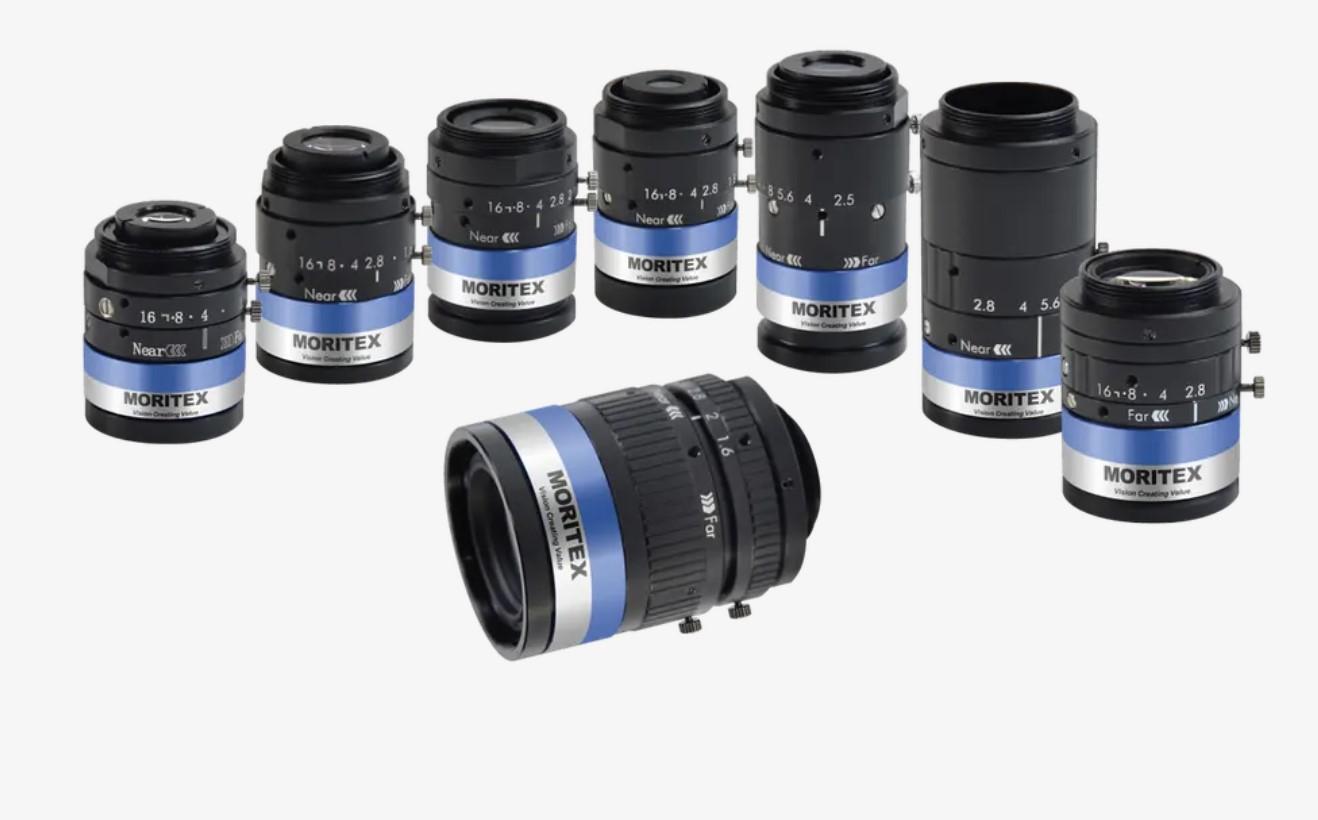
Resolution, accuracy, and field of view are determined before a single pixel is captured. We select and configure precision optics that match your measurement requirements — from standard lenses to telecentric and hypercentric designs.
5
Lens categories
< 0.1°
Telecentricity error
< 10 ms
Liquid lens response
0.5 mm+
Borescope diameters
Standard (Entocentric) Lenses
The foundation of machine vision optics
Standard entocentric lenses are the most widely used optics in machine vision. They have an angular, diverging field of view — objects further from the lens appear smaller, just like the human eye or any consumer camera.
How it works
Light rays enter the lens at diverging angles defined by the focal length and aperture. As an object moves further away, its magnification decreases proportionally. This perspective projection makes distant objects appear smaller relative to near objects within the same frame.
Think of it this way: They operate exactly like the human eye or a standard camera lens. If you look down a long hallway, the walls appear to converge in the distance — that's perspective distortion, and entocentric lenses exhibit the same behavior.
Best for
- General-purpose machine vision imaging
- Presence/absence detection
- Standard barcode and 2D code reading
- Color and texture inspection
- Applications where precise dimensional measurement is not critical
Key specifications
- Focal lengths from 4 mm to 100 mm+
- C-mount and CS-mount interfaces
- Fixed focal length and varifocal options
- Manual and motorized iris control
- Megapixel-rated for high-resolution sensors
Telecentric Lenses
Zero-distortion precision optics
Telecentric lenses use a complex parallel-ray optical design that completely eliminates perspective distortion (parallax). They maintain constant image magnification regardless of the object's distance from the lens, within the depth of field.
How it works
By placing an aperture stop at the rear focal point, only light rays entering parallel to the optical axis reach the sensor. This parallel-ray architecture means an object's apparent size does not change as it moves closer to or further from the lens — magnification remains constant across the entire depth of field.
Think of it this way: Imagine watching a train recede into the distance, but it never appears to shrink — it stays exactly the same size no matter how far away it gets. If you look straight down at a cylindrical pipe through a telecentric lens, you will only see the top rim, with no view of the inner or outer walls.
Best for
- High-precision dimensional metrology
- Accurate gauging with micrometer tolerances
- Edge detection on parts that vibrate or shift on a conveyor
- Flat-panel and wafer inspection
- Measurement applications requiring calibrated magnification
Key specifications
- Telecentricity error < 0.1°
- Magnification from 0.1× to 10×+
- Distortion < 0.1% across the field
- Large front element diameters for wide fields of view
- Fixed magnification (object-side telecentric) or bi-telecentric designs
Liquid Lenses
Dynamic focusing without moving parts
Liquid lenses abandon mechanical glass movement entirely. They use electrowetting technology — two immiscible liquids enclosed in an elastic polymer membrane — to change focal length electronically in milliseconds, with no mechanical wear.
How it works
An electrical current applied to the lens cell changes the electrostatic pressure on the interface between two immiscible liquids (typically oil and water). This instantly alters the curvature of the liquid meniscus, shifting the focal length without any moving glass elements. Response times are typically under 10 ms.
Think of it this way: They function almost exactly like the crystalline lens inside the human eye, which relies on ciliary muscles to instantly reshape itself and shift focus from a book in your hands to a mountain in the distance — but driven by electrical signals rather than muscle contractions.
Best for
- High-speed logistics and package sorting
- Inspecting objects at varying heights on a conveyor
- Multi-focal-plane inspection in a single station
- Barcode reading across varying working distances
- Any application requiring rapid, wear-free autofocus
Key specifications
- Focus response time < 10 ms
- No mechanical moving parts — zero wear
- Diopter range typically ±10 D or more
- Millions of focus cycles without degradation
- Compact form factor integrates into standard lens tubes
Hypercentric (Pericentric) Lenses
See the top and sides simultaneously
Hypercentric lenses use converging light rays instead of parallel or diverging ones. This unique optical geometry allows the lens to capture the top surface and all sides of an object simultaneously in a single image — from a single camera position.
How it works
By designing the entrance pupil to be larger than the object itself and positioning it in front of the object, light rays converge rather than diverge. This means the lens can 'see around' the object, capturing the top face and the full circumference of the side walls in one exposure without needing mirrors or additional cameras.
Think of it this way: Imagine being able to wrap your field of vision entirely around a soup can — reading the label on all sides and seeing the top lid at the exact same time, from a single vantage point directly above.
Best for
- Inspecting cylindrical objects (batteries, vials, bottles)
- Threaded cap and closure inspection
- Simultaneous top and side surface inspection
- Replacing multi-camera and mirror setups with a single camera
- Pharmaceutical container and label verification
Key specifications
- Converging (negative) viewing angle
- Object diameter determines maximum field of view
- Fixed working distance and magnification
- Designed for specific object size ranges
- Telecentric on the image side for sensor compatibility
Borescopes & Endoscopes
Inspecting what you cannot see
Borescopes and endoscopes are long, thin optical instruments — rigid or flexible — with a specialized lens system and integrated illumination at the tip. They allow visual inspection deep inside cavities, bores, and enclosed spaces that are otherwise impossible to reach.
How it works
A miniaturized lens system at the distal tip captures the image, which is relayed through the tube body via a series of relay lenses (rigid) or a coherent fiber optic bundle (flexible). Integrated LED illumination at the tip provides the necessary lighting inside dark cavities. The image is delivered to an eyepiece, camera adapter, or directly to a digital sensor.
Think of it this way: Very similar to the medical endoscopes a doctor uses to look inside the human body — but engineered with hardened optics and housings to withstand industrial fluids, high temperatures, and harsh environments.
Best for
- Non-destructive testing of internal cavities
- Inspecting machined engine cylinders and bores
- Aerospace turbine blade and weld inspection
- Internal pipe and tube surface inspection
- Quality verification inside assembled components
Key specifications
- Tube diameters from 0.5 mm to 12 mm+
- Working lengths from 50 mm to several meters
- Rigid, semi-rigid, and fully flexible configurations
- Integrated LED illumination at the tip
- Field of view from 40° to 120° with side-view and forward-view options
Choosing the right optics
Lens selection is one of the most critical decisions in a vision system. The right optics can make or break measurement accuracy. Here are the key factors we evaluate.
If sub-pixel or micrometer precision is required, telecentric optics eliminate the perspective errors that standard lenses introduce.
The physical space between the lens and the object constrains your lens choice. Borescopes solve tight-access problems; telecentric lenses require specific working distances.
The area you need to image determines focal length for standard lenses, or the front element diameter for telecentric optics.
Objects at varying distances need either telecentric optics (constant magnification across DOF) or liquid lenses (rapid refocusing).
Cylindrical, recessed, or enclosed objects may require hypercentric or borescope optics to capture surfaces that standard lenses simply cannot see.
Applications with rapidly changing object distances benefit from liquid lens technology — millisecond refocusing with zero mechanical wear.
Related technology
Optics are only one piece of the imaging chain. Explore the components that work alongside them.
Ready to solve your vision challenge?
Tell us about your application. Our engineers will evaluate your requirements and recommend the right approach — no obligation.